
1. Identify the exact legacy product
Paint names are frequently reused or altered across ranges. Record the label exactly, including volume, code, range, bottle or pot style, and an approximate purchase date. Photograph the front, barcode, and any batch information before the label degrades.
In the public BrushForge snapshot dated 10 July 2026, 405 paint-name groups occur more than once across brands or ranges. Even within a single brand, 296 name groups repeat. A product name by itself is therefore not a safe identity key; line and code materially reduce ambiguity.
2. Recover the role in the recipe
Was the paint an opaque base, a midtone, an edge highlight, a recess wash, a transparent filter, or a metallic? Write down how it was thinned, the layer beneath it, and what followed. A substitute only needs to reproduce the parts that matter for that step.
If the discontinued paint was used in a mix, record the partner colours and ratio. The replacement may match at full strength yet behave differently when mixed with white or another pigment.
3. Build a same-type candidate list
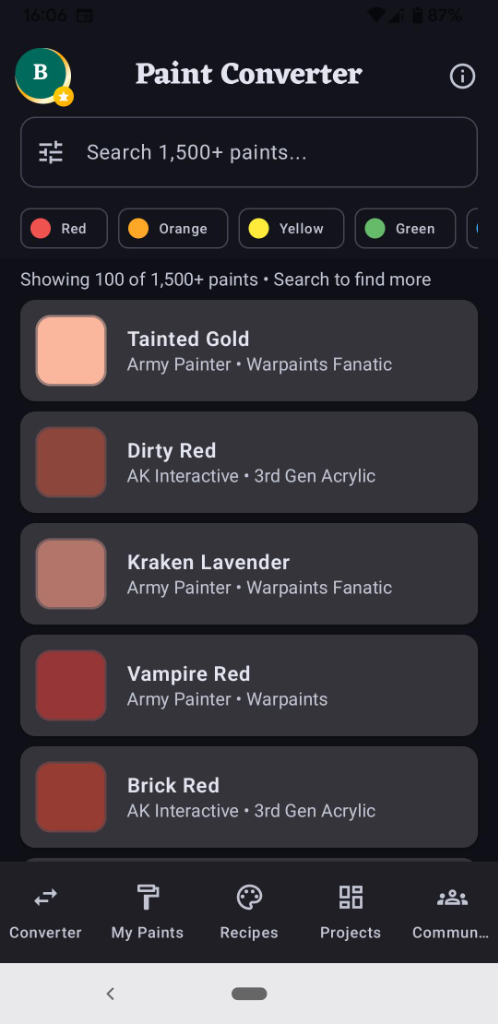
Search the BrushForge paint catalogue for the legacy record and inspect its identity and status. Then use a chart or converter to find current candidates in the same broad type: standard with standard, wash or transparent product with a similar behaviour family, and metallic with metallic.
Use ΔE2000 to order candidates by stored colour. A score at or below 5 is a useful shortlist where available. Above 10, the nearest candidate should be treated as a different colour that may require a mix or changes to neighbouring recipe steps.
4. Prefer a stable replacement
A close pot that is itself hard to source does not solve the problem. Check the manufacturer’s current catalogue, local availability, range status, and container size. If several candidates perform similarly, choose the one you can obtain consistently.
Do not overpay for old stock before considering condition. Acrylic paint can separate or thicken, seals can fail, and the product may no longer match the reference you are trying to preserve.
5. Compare the complete layer
- Use the intended primer and surface texture.
- Apply the original and candidates at the same working consistency.
- Compare one and two coats after full drying.
- Add the original next step—wash, layer, glaze, or highlight.
- Compare under neutral light and the lighting used for the finished miniatures.
- Varnish part of the test if the project is varnished.
If no single paint works, record a simple mix using current, stable products. Prefer ratios that can be reproduced with drops or brush loads, and save a dry swatch alongside the formula.
6. Update the recipe without erasing history
Keep the legacy name in the recipe and add the replacement beneath it: “Original product → current substitute, tested on [date], two coats over [primer].” This makes the decision auditable and avoids repeating the search when another member of the army is painted later.
Useful discontinued records can remain visible in BrushForge because painters still need to interpret old tutorials and project notes. A legacy page is not necessarily a current purchase recommendation; lifecycle and recommendation eligibility are separate concepts.
Sources and next reading
- What ΔE2000 means for miniature paints.
- How to translate a painting recipe between brands.
- Golden Artist Colors: Matte Fluid Acrylic Colors (discontinued), an example of manufacturer-provided legacy product and replacement guidance.
- BrushForge lifecycle, matching, and correction policy.